
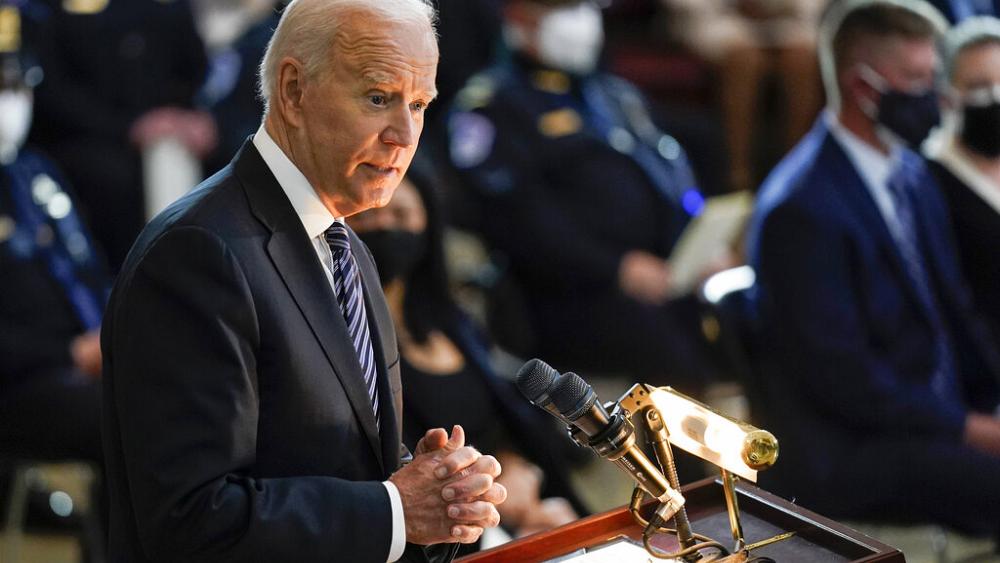
US President Joe Biden will withdraw all his country’s troops from Afghanistan by September 11, several US officials have said.
The date marks the 20th anniversary of the terrorist attacks on America that were coordinated from the country.
Biden will lay out his vision for the way forward in Afghanistan and the timeline for the withdrawal in remarks on Wednesday afternoon, The White House said.
The president will then visit Section 60 of Arlington National Cemetery to honour the sacrifice of those who died in recent American conflicts.
The US administration had originally planned to withdraw troops by May 1 as part of a peace agreement the Trump administration reached with the Taliban last year.
While Biden’s decision keeps US troops in Afghanistan four months longer than initially planned, it sets a firm end to two decades of war that killed more than 2,200 U.S. troops, wounded 20,000 and cost as much as €835bn ($1 trillion).
The conflict largely crippled al-Qaida and led to the death of Osama bin Laden, the architect of the September 11 attacks.
It recently became clear that an orderly withdrawal of the roughly 2,500 remaining troops in Afghanistan would be difficult and was unlikely by May 1.
No military solution
Defence officials and commanders had argued against the May 1 deadline, saying the US troop withdrawal should be based on security conditions in Afghanistan, including Taliban attacks and violence.
White House press secretary Jen Psaki did not provide details of Biden’s remarks planned for Wednesday but she said, during a White House briefing, that Biden “has been consistent in his view that there is not a military solution to Afghanistan, that we have been there for far too long.”
Psaki tweeted later on Tuesday that Biden’s visit to Arlington National Cemetery was “to pay his respects to the brave men and women who have paid the ultimate sacrifice in Afghanistan.”
According to the administration official, the only US forces remaining in Afghanistan will be those needed to protect diplomats there.
No exact number was provided, but American troop totals in Afghanistan have been understated by US administrations for years.
Officials have quietly acknowledged that there are hundreds more in Afghanistan than the official 2,500 number.
Biden’s new, extended timeline will allow a safe and orderly withdrawal of American troops in coordination with NATO allies, the administration official added.
The president’s decision, however, risks retaliation by the Taliban on US and Afghan forces, possibly escalating the 20-year war.
It will also reignite political division over America’s involvement in what many have called the endless war.
The German Defence Minister also said NATO soldiers engaged in Afghanistan are likely to withdraw by September.
Speaking ahead of a meeting of defence and foreign ministers of NATO members on Wednesday, Annegret Kramp-Karrenbauer said: “I am for an orderly withdrawal, which is why I suppose we will decide this today.”
During a videoconference the Alliance is expected to make a decision on whether the time is right to end the “Resolute Support” mission in Afghanistan which includes 9,600 troops from 36 countries.
- Watch: September 11 terror attacks remembered at ceremonies across US
- ‘Historic’ peace talks between Afghan government and the Taliban begin after decades of war
- At least eight killed in car bomb explosion in Afghanistan’s western Herat province
An intelligence community report issued Tuesday about global challenges for the next year said prospects for a peace deal in Afghanistan are “low” and warned that “the Taliban is likely to make gains on the battlefield.
If the coalition withdraws support the Afghan government will struggle to control the Taliban, the report says.
Reaction to the new deadline has been mixed.
“Precipitously withdrawing US forces from Afghanistan is a grave mistake,” said Senate Republican leader Mitch McConnell, R-Ky. “It is retreat in the face of an enemy that has not yet been vanquished and abdication of American leadership.”
‘Sacrificed too much’
Sen. Jim Inhofe of Oklahoma, the ranking Republican on the Senate Armed Services Committee, slammed the move as a “reckless and dangerous decision.”
He said any withdrawal should be conditions-based, adding that arbitrary deadlines could put troops in danger, create a breeding ground for terrorists and lead to civil war in Afghanistan.
Democrat, Sen. Jack Reed, D-R.I., chairman of the Armed Services Committee, said President Donald Trump’s May 1 deadline limited Biden’s options.
“We still have vital interests in protecting against terrorist attacks that could be emanating from that part of the world, but there are other areas, too, we have to be conscious of,” Reed said.
But at least one senior Democrat expressed disappointment; Sen. Jeanne Shaheen of New Hampshire said in a tweet that the US “has sacrificed too much to bring stability to Afghanistan to leave without verifiable assurances of a secure future.”
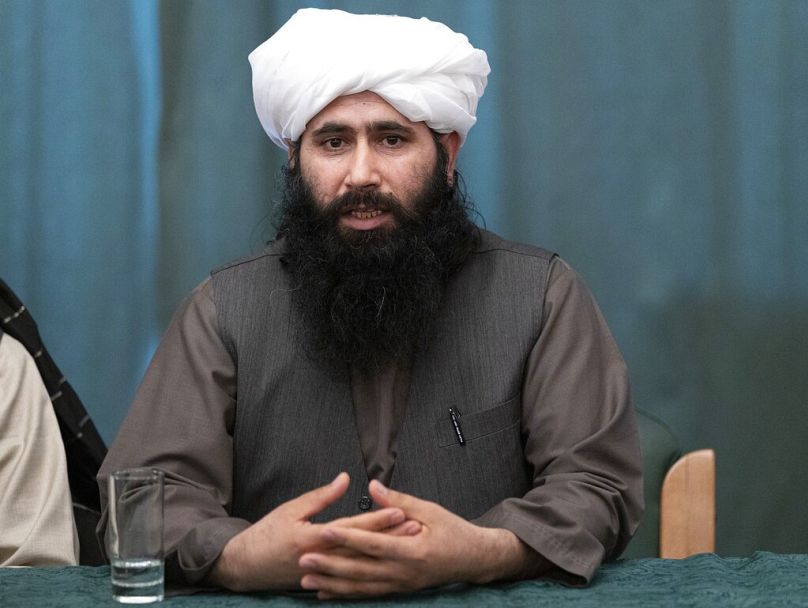
Taliban spokesman Zabihullah Mujahed told the AP that the religious militia is waiting for a formal announcement to issue its reaction. The Taliban previously warned the US of “consequences” if it reneged on the May 1 deadline.
In a February 2020 agreement with the Trump administration, the Taliban agreed to halt attacks and hold peace talks with the Afghan government, in exchange for a U.S. commitment to a complete withdrawal by May 2021.
When Biden entered the White House in January, he began a review of the February 2020 agreement and has been consulting at length with his defence advisers and allies.
In recent weeks, it became increasingly clear that he was leaning toward defying the deadline.
“It’s going to be hard to meet the May 1 deadline,” Biden said in March. “Just in terms of tactical reasons, it’s hard to get those troops out.” He added, “And if we leave, we’re going to do so in a safe and orderly way.”