
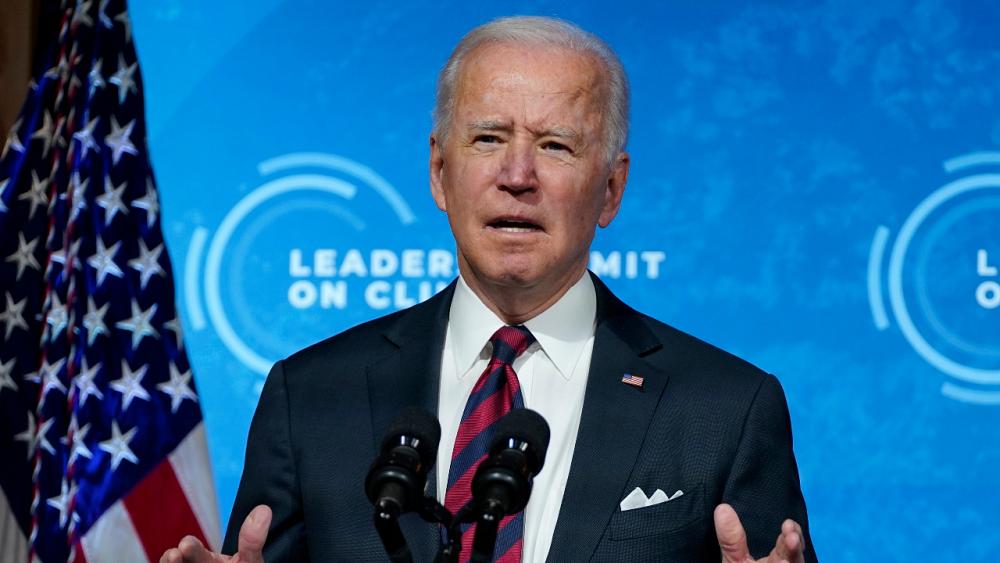
US President Joe Biden and Vice President Kamala Harris kicked off a virtual summit on Thursday bringing together 40 world leaders for talks on the climate crisis.
The virtual summit, which marks Earth Day and ends on Friday, comes after the new US administration rejoined the Paris climate agreement in February, reversing former President Donald Trump’s withdrawal.
It also began as the Biden administration announced a new ambitious target in reducing US greenhouse gas emissions – at least a 50% cut by 2030, compared to 2005 levels.
“This is a moment of extraordinary possibility,” Biden said in opening remarks as he launched the summit Thursday morning.
“The science is undeniable” when it comes to the realities of the climate crisis, he said, while the “cost of inaction keeps mounting”.
Meanwhile, Vice President Kamala Harris warned that “the health of our communities, the wellbeing of our workers and the strength of our economy depend on what we do now”.
She said she could “think of no one more committed to achieving our collective goals than President Joe Biden”.
‘Hugely significant’ to have US back on board
Having the US back in the climate talks is “hugely significant,” Heather Alberro, professor of environmental politics at Nottingham Trent University, told Cuffnews.
But the US “remains a major economy with a significant carbon footprint,” Alberro added, and it is being pushed by “social movements” for an even higher reduction – “at least 70%”.
- US and China agree to cooperate on climate crisis with urgency
- More than 700 million children are living on the frontlines of the climate crisis
Leaders from around the world join talks
Chinese leader Xi Jinping and Russian President Vladimir Putin are among those participating in the summit.
Speaking early on in the event, Xi called on the global community to “be committed to harmony between man and nature”.
“Mother nature has nourished us, we must treat nature as our root,” he said. “Respect it. Protect it. Follow its laws.”
He also said countries must be committed to green development, asserting that “green mountains are gold mountains”.
Earlier this month, US climate envoy John Kerry struck an agreement with his Chinese counterpart Xie Zhenhua to work with other countries to address the climate crisis.
The two countries, which are the world’s two biggest polluters, came to the agreement during talks in Shanghai.
In a joint statement, they said: “The United States and China are committed to cooperating with each other and with other countries to tackle the climate crisis, which must be addressed with the seriousness and urgency that it demand.”
2050 goal an ‘achievable task’, Putin says
Meanwhile, Putin said that whether the global effort to address the climate crisis “proves successful will largely determine the future of our planet”. He said Russia treats its “international commitments with the utmost responsibility on this sphere”.
Putin said Russia was committed to “significantly reducing the net accumulated emissions in our country by 2050,” adding: “I’m confident that despite Russia’s size, its geography, climate and economic structure, this task is achievable.”
India’s Prime Minister Narendra Modi told participants that his country, the world’s third emitter of fossil fuel fumes, is “doing our part” to address the climate crisis.
“We have taken many bold steps,” he said. However, he said India would also welcome international partners on promoting sustainable development in India.
bangladesh Prime Minister Sheikh Hasina said the nation has “emerged as a global leader on adaptation and mitigation”.
“Every year, we are spending on an average $5 billion US dollars – about 2.5% of our GDP – on climate adaptation and resilience building measures,” she said.
The leader said that the coronavirus pandemic should be a reminder that global crises can only be addressed through a concerted effort.
Macron: ‘2030 is the new 2050’
French President Emmanuel Macron said France was “making progress” on reducing methane emissions.
With the US and other countries setting new ambitious targets to reduce emissions within the next decade, Macron said: “2030 is the new 2050”.
Japanese Prime Minister Yoshihide Suga said his country was also “accelerating” its efforts to address the climate crisis and meet expedited goals.
The prime minister noted how after assuming office, he had outlined the target of achieving “net zero by 2050” and said “we will take a big step towards the resolution of this global issue”.
He said the country also aims to reduce greenhouse gas emissions by 46% by the fiscal year 2030.
Johnson: Not just a ‘green act of bunny hugging’
British Prime Minister Boris Johnson, meanwhile, touted the UK’s recent ramping up of its efforts to address the climate crisis, with Britain’s government announcing plans to cut carbon emissions to 78% of 1990 levels before 2035.
Previously, the UK had aimed to meet the target by 2050.
Mr Johnson further said that as countries seek to rebuild following the coronavirus pandemic, they can “build back better” by “building back greener”.
He also quipped that the climate summit was about showing the global community that world leaders are committed to more than just “bunny hugging”.
He said he hoped to “show that this is not all about some expensive, politically correct green act of bunny hugging, or however you want to put it…you know what I’m driving at…this is about growth and jobs”.
European Commission President Ursula Von Der Leyen said this is a “make or break” decade for climate and said “we need the world” to come together to address the climate crisis.
She also said it was good to have the US “back on our side in the fight against climate change”.
German Chancellor Angela Merkel said the bid to tackle the climate crisis was a “Herculean task” requiring a “complete transformation of the way we do business and the way we work”.
“Germany has already reduced its emission by 40[%] compared to 1990 and the European Union will be neutral by 2050,” she said.
Canadian Prime Minister Justin Trudeau said that while the country’s priority continues to be “battling COVID-19,” particularly amid a recent surge in cases in parts of the country, he said the nation is also committed to addressing the “existential threat” of the climate crisis.
He said the country was now committed to slashing carbon emissions by 40% to 45% by 2030 compared to 2005 levels.
“When Canadians elected us five years ago, our emissions were projected to keep rising to 2030,” he said. “But, with hard work and a solid plan, Canada is now on track to blow past our old target of 30% reduction below 2005 levels.”
A ‘shared challenge’
During his own statements at the climate summit’s opening, Secretary of State Antony Blinken said he hoped that countries could explore “every possible avenue of cooperation on climate”.
“If we work together we can do more than just address this crisis,” he said, asserting that cooperation on climate could “lay the foundation for cooperation on other shared challenges”.
“There are many issues on which we don’t all see eye-to-eye,” he acknowledged. However, he said: “This isn’t one of them. No matter what country we’re from we know the world we want to pass on to our children and our grandchildren. I can think of no better or more urgent cause to bring us together.”
The Biden-led summit will undoubtedly set the tone for the upcoming 26th UN Climate Change Conference, COP26, which takes place in November in Glasgow, Scotland, with the US government asserting that a key focus of the talks will be the “urgent need for the world’s major economies to strengthen their climate ambition by the time of COP26”.