
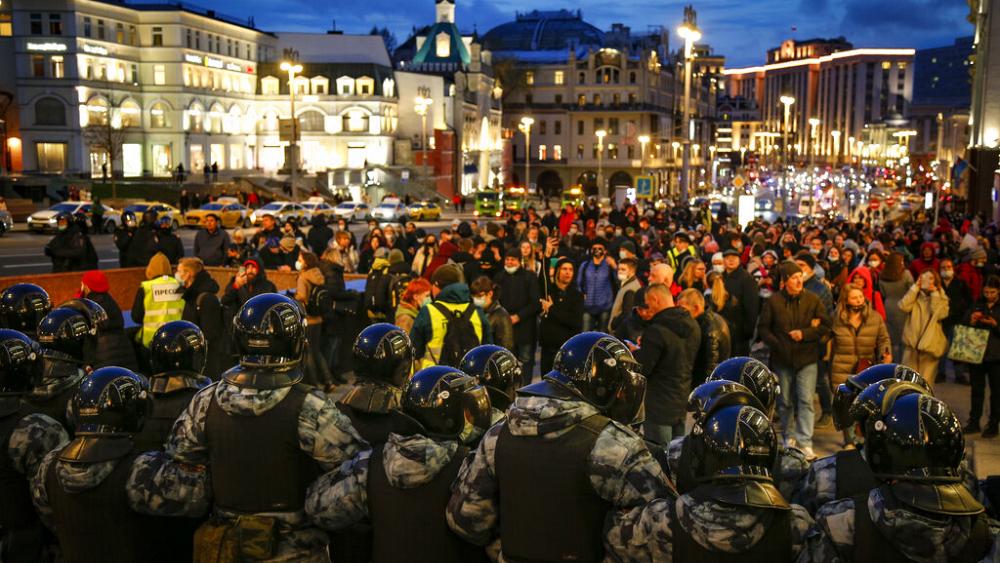
Mass rallies were taking place in St. Petersburg and Moscow on Wednesday evening even as Russian authorities detained hundreds of supporters of Kremlin critic Alexei Navalny.
The OVD-Info group, a human rights monitor, reported 413 arrests in 60 cities. Many people were apprehended before protests even began, including two top Navalny associates in the Russian capital.
Allies of the imprisoned Russian opposition leader had called for rallies in around 100 cities across Russia on Wednesday.
The demonstrations began at 7pm local time in each city, moving west across the country, and were arranged to coincide on the same day as Russian President Vladimir Putin’s annual address.
The protests in Russia’s two largest cities were held under heavy police presence shortly after UN experts said Navalny should be evacuated for urgent medical treatment abroad.
- Alexei Navalny should be evacuated for urgent medical treatment abroad, say UN experts
Navalny’s organization called for the Moscow protesters to assemble on Manezh Square, just outside the Kremlin, but police blocked it off.
Instead, the itinerary was changed to include Tverskaya Street, which is the main road leading up to the Kremlin, the State Duma and the Bolshoi Theater, all the way to the FSB’s headquarters, Navalny’s team said on Twitter.
- Alexei Navalny should be evacuated for urgent medical treatment abroad, say UN experts
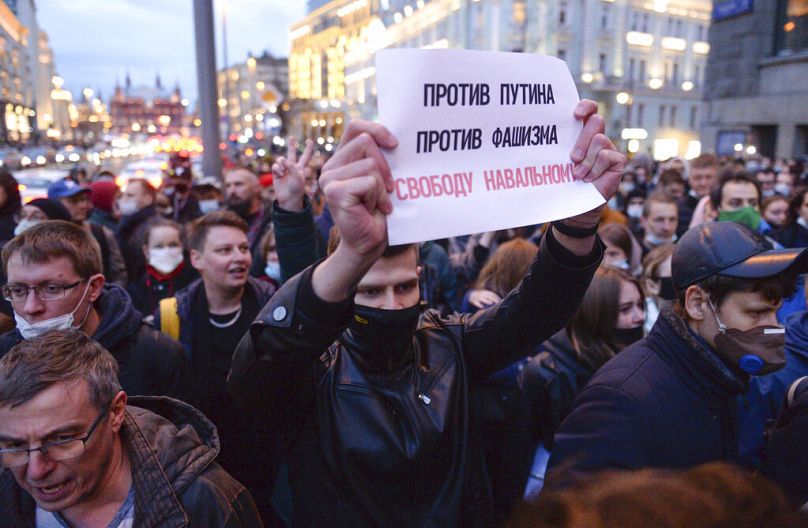
Footage released by news agencies showed thousands of protesters marching through central Moscow. Russia’s Interior Ministry said 6,000 people were participating in Moscow and 4,500 in St. Petersburg, while observers put the figure in Moscow in the tens of thousands.
Police in Russia’s fourth-largest city, Yekaterinburg, estimated the protest size at 5,000 people while Navalny’s local office estimated the crowd size at 13,000 to 14,000.
“This is real Russia – free and without fear!” Navalny’s team tweeted along with pictures of streets crowded with protesters in the capital.
In St. Petersburg, police blocked off Palace Square, the vast space outside the Hermitage Museum, and protesters instead crowded along nearby Nevsky Prospekt.
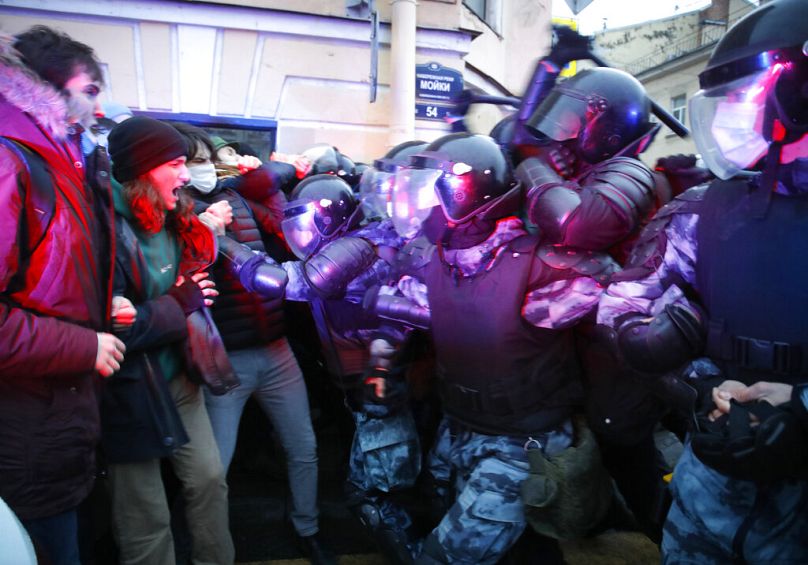
Footage posted on social media showed a young female protester in St. Petersburg brutally taken away by riot police.
View this post on Instagram
In Vladivostok, several hundred protesters marched peacefully under police surveillance, chanting “freedom for political prisoners”.
There were no comprehensive reports of turnout throughout the country and it was unclear if the rallies would match the size and intensity of protests held in January after Navalny was arrested.
Security presence
In the capital city, police had ramped up security presence on the streets and closed Red Square earlier in the day.
The country’s Interior Ministry and the Prosecutor’s Office had warned days earlier that they would take “measures” if unauthorised rallies were held.
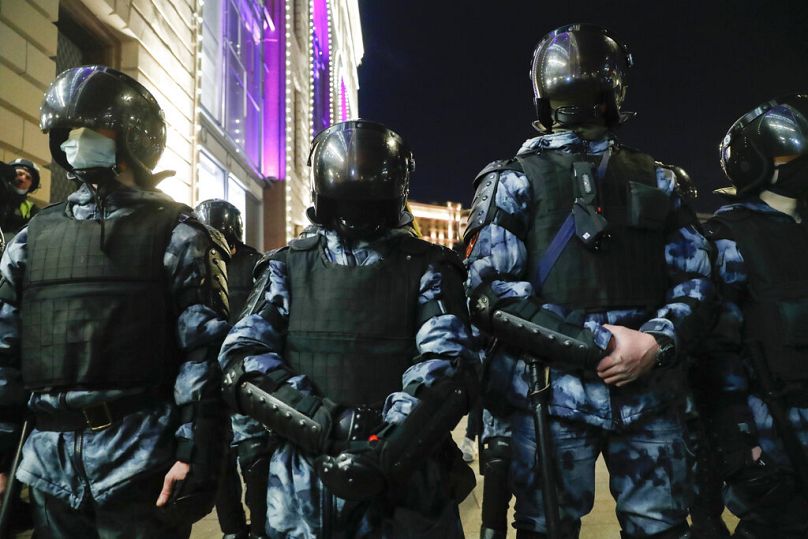
Previous nationwide protests in support of Navalny in January resulted in more than 11,000 arrests and at least seven lengthy prison sentences on charges of “violence” against the police.
Close allies of Navalny detained
Two close associates of the Kremlin critic were also detained hours before Wednesday’s protests were due to begin.
Lyubov Sobol, a close ally of Navalny, was removed from a taxi near a Moscow metro station on Wednesday morning by people in “uniform”, her lawyer said on Twitter.
Meanwhile, police arrested Navalny’s spokeswoman Kira Yarmysh near the entrance of her apartment building, according to her legal team. Her lawyer later tweeted to say that Yarmysh, who was already under house arrest with no internet, had been sentenced to 10 days in a detention center for posting an unauthorized tweet.
Searches have also been carried out on premises linked to the Kremlin opponent’s anti-corruption organisation.
EU criticises arrests
“The detention of supporters of Alexei Navalny in advance of planned protests in Russia today are deplorable,” said Charles Michel, President of the European Council.
“Authorities must respect the right to assembly,” he added on Twitter.
“I urge that the necessary and quality medical care be granted to Alexei Navalny and that he be released from prison.”
Navalny was arrested in January upon his return from Germany, where he had spent five months recovering from a nerve agent poisoning he blames on the Kremlin. Russian officials have rejected the accusation.
He was sentenced to a 2 and 1/2 years prison sentence for a 2014 fraud charge, which human rights organisations have labelled “political”.
On March 31, Navalny began a three-week hunger strike in prison to protest against officials’ refusal to let him be treated by his doctor for back pain and other ailments. Russia’s penitentiary service has said Navalny was getting all the medical help he needs.
But on Saturday, Navalny’s personal physician said the opposition leader’s health was deteriorating and has demanded that he be transferred to a civilian hospital.