
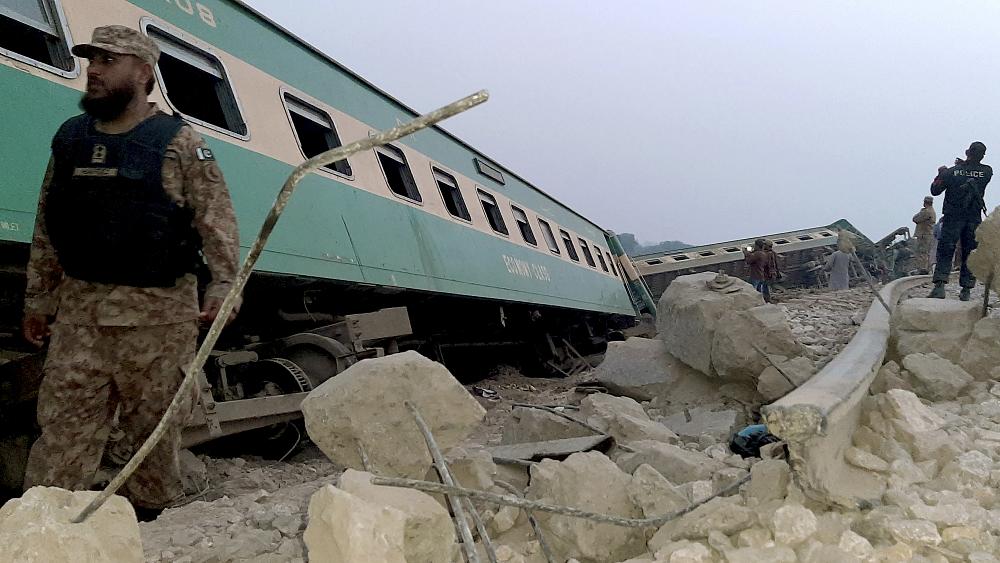
Two express trains collided in southern Pakistan early Monday, killing at least 40 passengers and injuring more than 100, authorities said, as rescuers and villagers worked to pull injured people and more bodies from the wreckage.
The Millat Express derailed at 3:30 am and was hit minutes later by the Sir Syed Express. It wasn’t immediately clear what caused the derailment and the subsequent collision.
Pakistani Prime Minister Imran Khan said on Twitter that he was “shocked by the horrific train accident” and that he had asked the railway minister to supervise the rescue work and also ordered a “comprehensive” probe into the crash.
As daylight broke, between 15 to 20 passengers were still trapped in the wreckage of the Millat Express train.
“Right now the challenge for us is to quickly rescue those passengers who are still trapped in the wreckage,” Umar Tufail, a police chief in the district, said.
According to railway officials, about 1,100 passengers were on board the two trains, and arrangements were being made to help the surviving passengers.
According to local media, some of the passengers were travelling by the Millat Express train to attend a wedding party but it was unclear whether they were among the dead or injured.
TV footage showed ambulances transporting injured passengers to hospitals. According to Pakistani TV stations, heavy machinery had not reached the scene about four hours after the crash.
Some of the injured passengers were listed in critical condition at a hospital.
Officials at Pakistan railways said they had ordered an investigation and rescue work was still in progress.
Authorities said troops had been deployed at the scene of the accident to participate in the rescue work. Heavy machinery also arrived to cut open some cars, in the hopes of rescuing several people still believed to be trapped.
Earlier, Azam Swati, the minister for railways who headed to the scene of the crash, told The Associated Press that engineers and experts were trying to determine what caused the collision and that all aspects would be examined, including the possibility of sabotage.
Habibur Rehman Gilani, chairman of Pakistan Railways, told Pakistan’s Geo News TV that the segment of the railway tracks where the crash took place was old and needed replacing. He did not elaborate.
Aijaz Ahmed, the driver of the Sir Syed Express, told the station that on seeing the derailed train, he tried his best to avoid the crash by braking but failed. Railway officials said Ahmed was slightly injured, and villagers pulled him from the train’s engine after the crash.
Mohammad Amin, one of the passengers on the Millat Express who had minor injuries, told the AP from a hospital that before the train departed from the southern port city of Karachi, he and his brother, who was also on the train, saw railway mechanics working one of the coaches.
That led them to believe there was something wrong with it but they were reassured all was fine.
The train car that was being worked on was the one that later derailed, Amin claimed.
Train accidents are common in Pakistan, where successive governments have paid little attention to improving the poorly maintained signal system and ageing tracks.
In 1990, a packed passenger ploughed into a standing freight train in southern Pakistan, killing 210 people in the worst rail disaster in Pakistan’s history.